

Halal certification dispute between IF, BSTI leaves exporters in limbo
Bangladesh’s ambitions to tap into the multi-trillion-dollar global halal market are being undermined by an unresolved turf war between two state agencies over who has the authority to certify halal products, leaving exporters burdened by costly dual certification, regulatory confusion and limited international acceptance.
Businesses and experts say the parallel halal certification systems run by the Islamic Foundation (IF) and the Bangladesh Standards and Testing Institution (BSTI) have become a major barrier to competitiveness, even as global demand for halal food continues to surge among Muslim and non-Muslim consumers alike.
The dispute has prompted calls for urgent government intervention to unify the process, secure international recognition and unlock export growth.
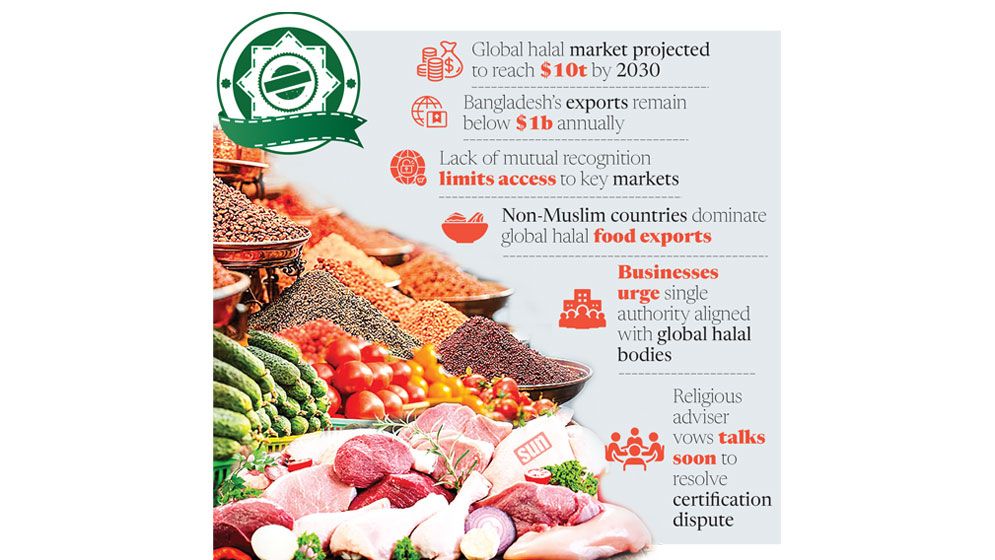
The global halal market is valued at over $7 trillion and is projected to reach $10 trillion by 2030, growing at a compound annual rate of 5.5%, according to the American Halal Foundation.
Saudi Arabia alone accounts for an estimated $207 billion in Muslim consumer spending.
By contrast, Bangladesh’s halal export earnings remain below $1 billion, with shipments worth $988.6 million – mostly agro-based products – recorded in the 2024–25 fiscal year, data from the Export Promotion Bureau (EPB) show.
Industry insiders argue that high domestic costs, limited product diversification and weak market strategies have all constrained Bangladesh’s progress.
However, the most persistent complaint remains the “dual certification” requirement imposed by IF and BSTI, which they say inflates compliance costs and weakens credibility in international markets.
Government moves to defuse the dispute
Religious Affairs Adviser Dr AFM Khalid Hossain told the Daily Sun that the government is working to resolve the certification deadlock and will soon convene a meeting of advisers and senior officials.
“We will sit with other advisers and secretaries soon to resolve the certification dispute,” he said.
“Businesses can take certification from any government institution. But as this is a halal issue, the responsibility goes to the Islamic Foundation.”
He stressed that BSTI’s mandate is limited to testing product standards, not religious compliance.
“Halal is a Shariah issue. A product may meet BSTI standards but still be disqualified if it does not comply with Shariah. Therefore, religious issues should be handled by the Ministry of Religious Affairs or the Islamic Foundation,” Dr Khalid said.
Highlighting the export opportunity, he added, “There is huge demand for ‘Made in Bangladesh’ halal products in the global market. We should grab this opportunity. Halal products are also gaining popularity among non-Muslims as they are tested and considered conducive to human health.”
Exporters caught between two certifiers
Md Maidul Islam, chief marketing officer of Akij Food and Beverage Ltd, said Bangladesh has immense potential in halal agro-products but remains hamstrung by bureaucratic hurdles.
“Businesses are required to take certification from two government agencies – the Islamic Foundation and BSTI – which creates unnecessary difficulties,” he said, noting that Akij has been exporting halal products such as spices and biscuits for 15 years with certification from IF.
“The Islamic Foundation’s certification is recognised in many more countries than BSTI’s,” he said. “Although IF does not have its own laboratory, it tests products through accredited bodies like BCSIR and works in collaboration with Malaysia’s JAKIM. This gives us acceptance in Middle Eastern and EU markets.”
By contrast, he said, BSTI’s halal certification has limited international outreach.
Maidul urged the government to establish a single halal authority aligned with international bodies to ensure global access for Bangladeshi products.
Meat exporters flag compliance gaps
Ahmad Asif, chief executive officer of Bengal Meat Processing Industries Ltd, said his company holds halal certifications from both IF and BSTI to meet varying requirements.
“We started exporting halal meat when there was no certification framework in Bangladesh,” he said. “Initially, we exported with certification from Malaysia’s JAKIM.”
He said Bengal Meat began exports in 2006 via Dubai and now ships beef, mutton and chicken to markets such as the Maldives.
While Bangladesh lags in price competitiveness overall, he said demand for premium Bangladeshi beef is strong in developed markets. “Our biggest barrier is compliance,” Asif said. “To enter the EU and other advanced markets, we need a recognised ‘disease-free zone’.”
Call for mutual recognition agreements
PRAN Group Managing Director Eleash Mridha said the conglomerate obtained halal certification from IF in 2015 and from BSTI in 2023, having earlier secured certification from JAKIM in 2010 to enter the Malaysian market.
“Currently, PRAN exports around $40 million worth of halal-certified products annually,” he said, covering juices and beverages, snacks, confectionery, culinary items and frozen foods.
Malaysia remains PRAN’s largest halal market, followed by Brunei and select European and North American destinations.
He warned, however, that the absence of mutual recognition agreements with major halal authorities is a serious bottleneck.
“There are no mutual agreements between Bangladesh’s Islamic Foundation and authorities such as China’s Halal Authority, JAKIM or Indonesia’s MUI,” he said. “As a result, independent applications become time-consuming and costly due to repeated audits.”
Islamic Foundation pushes back
Islamic Foundation Deputy Director (Halal Certification) Dr Md Abu Saleh Patoari said IF has issued halal certification since 2007.
As of January 1, 2026, 276 companies had been certified, including 66 exporters shipping 600 halal products to 45 countries.
“We have recognition from JAKIM, and 90 per cent of the process to enlist with Saudi Arabia has been completed,” he said, ADDING, “If we are included in the Saudi list, exports will increase significantly.”
He alleged that BSTI officials now compel businesses to obtain BSTI halal certification when they approach the agency for standard testing.
“BSTI has no right to issue halal certification, as this is a religious matter,” he said, adding that IF and BSTI worked jointly until 2022, when BSTI began issuing its own certificates.
While IF currently relies on laboratories such as BCSIR, Patoari said plans are under way to establish its own facilities.
BSTI defends its role
BSTI, however, maintains that it is strengthening Bangladesh’s halal infrastructure.
Industries Adviser Adilur Rahman Khan inaugurated the National Halal Laboratory (NHL) at BSTI on July 14, 2025, describing it as a key initiative to boost export potential.
“BSTI’s journey towards halal certification and the establishment of a national halal laboratory is a timely decision,” he said.
BSTI Deputy Director (Halal Certification) SM Abu Sayed said the institution has issued 202 halal certificates to 25 companies, covering products such as biscuits, cakes, chocolates, honey, noodles, frozen fish, meat and paratha.
“After long efforts, we obtained membership of OIC/SMIIC in 2022,” he said. “We now have advanced PCR machines capable of porcine derivative testing and can conduct all halal and non-halal tests.”
Non-Muslim countries dominate the market
Despite being Muslim-majority, countries like Bangladesh lag behind non-Muslim exporters in capturing the halal market. Leading exporters include Brazil (10.7%), India (9%), the United States (4.9 %), China (4.6%), Thailand (4.4%) and Australia (4.4%). Brazil alone exports halal meat worth $5.19 billion annually.
Experts estimate that even capturing 2–3 per cent of the global halal market could significantly boost Bangladesh’s economy and open new opportunities for entrepreneurs, particularly as the country prepares for the post-LDC era.
Bangladesh’s untapped potential
Prof Dr Mohd Ma’Sum Billah, senior professor of finance at King Abdul Aziz University in Saudi Arabia, said Bangladesh’s large Muslim population gives it a natural advantage.
“Bangladesh can become a halal trading or barter hub,” he said, citing strong demand for meat, poultry, fish, gelatin and fruit-based products.
He recommended a unified national halal policy under government oversight, led by the Ministry of Religious Affairs, with the Islamic Foundation ensuring standardisation and Shariah compliance through qualified scholars and audit boards.
“Every product must be scrutinised by both Shariah and scientific authorities,” he said, stressing that quality assurance aligned with international standards is essential for global acceptance.
Share This Post


Partner Events: