


Indonesia’s Economic Diplomacy Through Modest Fashion
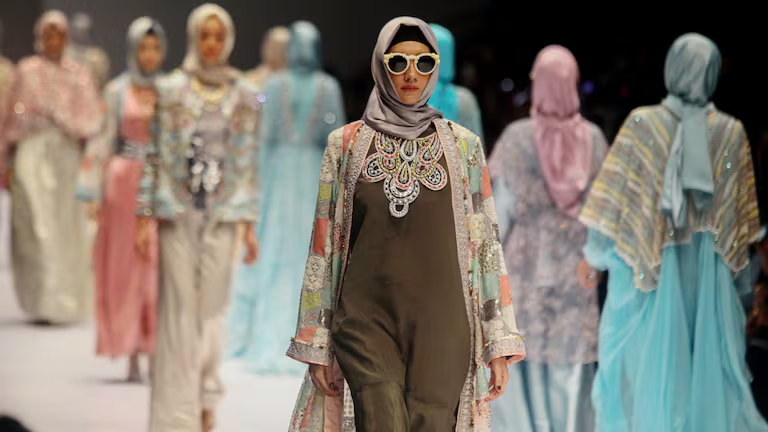
The runway lights at the Jakarta International Convention Center went dark on October 18, closing five days of IN2MOTIONFEST × JMFW 2026, part of the 13th Indonesia Sharia Economic Festival (ISEF), Bank Indonesia’s flagship platform for advancing the country’s Islamic economy and finance.
More than 300 designers, brands, SMEs, and members of Indonesia’s Sharia Creative Industry Council took part in runway shows, trade exhibitions, and business matching, organized by Bank Indonesia alongside the Ministry of Trade and the Indonesian Fashion Chamber.
The applause was well-earned. The real test of economic diplomacy, though, is what Indonesia’s embassies and trade attachés abroad do with that admiration once the lights go out.
The stakes are genuinely significant. The State of the Global Islamic Economy 2024/2025 report ranks Indonesia first in the world in modest fashion, as global Muslim clothing spending is projected to climb from US$327 billion in 2023 to US$433 billion by 2028.
That top ranking has not yet carried into trade with fellow Muslim-majority economies. Indonesia’s modest fashion exports to the 57 member states of the Organization of Islamic Cooperation (OIC), a bloc Indonesia has long courted as a platform for economic diplomacy, reached just US$990 million in 2023, placing it seventh, behind China, Turkey, and India.
Broader exports tell a steadier story: from US$6.9 billion in 2020 to US$8.4 billion in 2024, according to Indonesia’s Ministry of Trade, before growth eased to 3.9 percent in the January-October 2025 period, reaching US$7.1 billion. Every additional dollar still strengthens foreign exchange supply and, over the medium term, supports the current account and the rupiah.
The domestic base for this growth is already substantial. The small-scale garment industry, a broader category than modest fashion alone, comprised roughly 594,000 business units employing 1.2 million workers in 2024, per Statistics Indonesia (BPS).
Turning that capacity into exports is where festivals like this one come in, functioning as meeting engines for economic diplomacy. Organizers are positioning Indonesia as a global modest fashion sourcing hub, leaning on trade attachés stationed at Indonesian embassies abroad, diplomats whose job is to turn commercial curiosity into contracts, to bring in foreign buyers.
Curation has shifted toward commercial readiness rather than design beauty alone, and the November 2025 edition of JMFW shows why that matters. Total transactions reached US$19.51 million, beating the initial US$10 million target, with roughly 38 percent, or 122 billion rupiah, coming from SMEs.
Of that total, US$15.30 million, about 78 percent, took the form of memorandums of understanding (MoUs), while direct transactions on the exhibition floor added just US$436,000 and business matching contributed US$3.77 million. An MoU, like a joint communiqué, signals intent. It is not yet a binding commitment.
Value added to GDP and foreign exchange is created only once an order is manufactured, shipped, and paid for. The number worth tracking after any festival, then, is how many MoUs convert into purchase orders, and how many buyers come back to order again.
Closing that gap depends on three levers. The first is production quality and capacity. Foreign buyers look for consistent quality, reliable delivery schedules, and volumes that can be fulfilled at scale, a skill set that regional collections, such as those from Tegal and Borneo featured at the festival, are building through mentorship in design, production standards, and business management, with guidance from Bank Indonesia, relevant ministries, and industry associations.
The second lever is financing. Export orders require working capital to purchase materials, pay tailors, and cover the gap before payment arrives, and working capital schemes, including sharia-compliant financing designed around order cycles rather than collateral alone, can close that gap, with Bank Indonesia, banks, and Islamic financial institutions helping match SMEs that already have buyers to the right financing sources.
The third lever is systematic follow-through, and this is where diplomacy does its quiet work. Trade attachés and Indonesia’s Trade Promotion Centers (ITPCs) abroad can work alongside Bank Indonesia’s own overseas representative offices and digital marketplaces to keep a buyer relationship alive long after the festival ends, through logistics, export documentation, and payment, so the relationship built on the convention floor does not end when the buyer flies home.
None of these three levers moves on its own, though. Archimedes famously said, “Give me a lever long enough and a place to stand, and I will move the world.” The lever that moves these three is coordination, carrying a diplomatic dimension of its own.
The Ministry of Trade, the Ministry of Industry, the Ministry of Foreign Affairs, Bank Indonesia, banks, designer associations, and local governments each carry their own mandates, and a shared roadmap keeps their efforts aligned rather than moving in isolation.
Bank Indonesia’s regional representative offices can serve as connectors, so SMEs outside Jakarta have a stake in a festival happening in Jakarta rather than watching from a distance. The tourism spillover that Indonesia’s Tourism Minister has pointed to, spanning hotels, dining, transport, and retail, grows stronger as buyers return repeatedly rather than visiting once.
What is at stake is not how to stage a dazzling festival, but how to measure what happens after it. As meetings become orders, orders become work for artisans and tailors, and work becomes foreign exchange, the stage will have done its part in advancing Indonesia’s economic diplomacy.
Indonesia already holds first place in the rankings. Turning that into economic diplomacy that shows up on the trade balance depends on whether its embassies and trade attachés can convert admiration abroad into orders, backed at home by quality, financing, and genuine follow-through.
The stage may go dark when the festival ends. The sewing machines, the looms, and the trade relationships built on this stage are what must keep running.
Source: https://thediplomaticinsight.com/indonesia-economic-diplomacy-modest-fashion/
Share This Post

Partner Events: